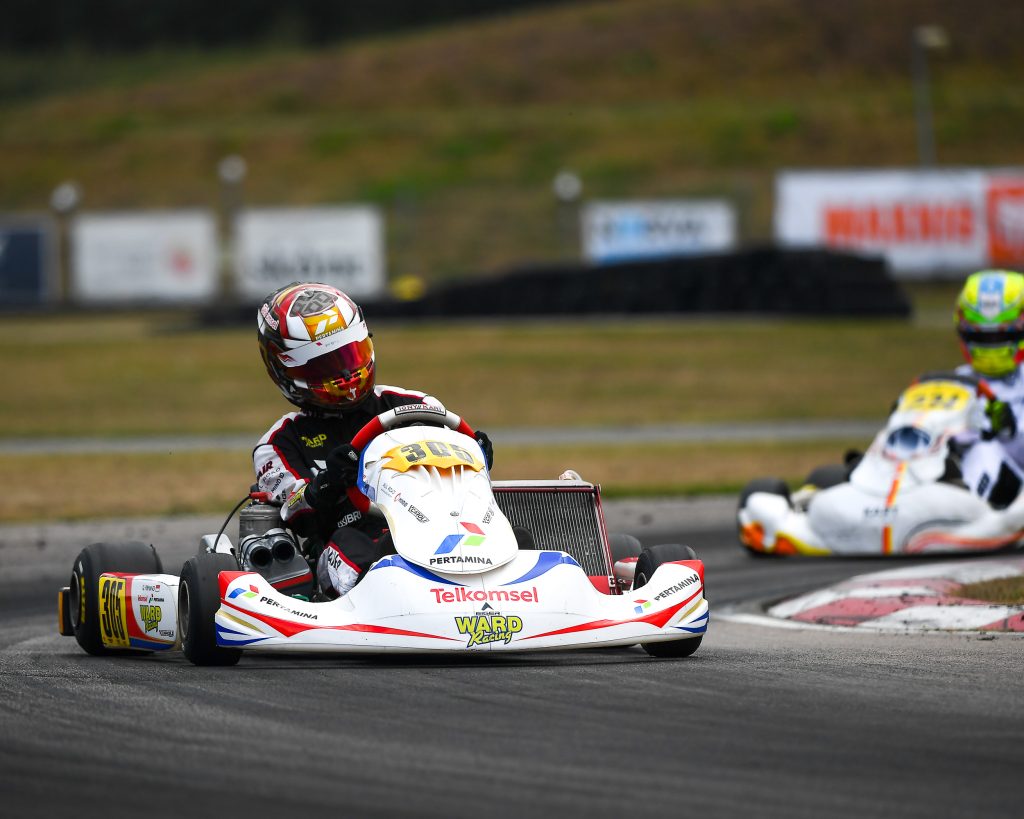
While many see motorsport as a test of bravery, professional drivers like Qarrar Firhand—a leading Indonesian Young Racer—view it as a high-speed physics laboratory. To succeed on the Road to Formula 1, a driver must graduate from being a “steering wheel holder” to becoming a technical collaborator with engineers.
This article explores the scientific principles and advanced technologies that Qarrar uses to gain a competitive edge on the world’s most demanding circuits.
1. The Physics of the “Racing Line”
The most fundamental lesson in Qarrar’s education is geometry. The fastest way around a corner isn’t always the shortest distance; it’s the path that allows the highest average speed.
Apex Management: Qarrar must identify the “apex” (the innermost point of a turn). By hitting a late apex, he can straighten the car earlier, allowing for maximum acceleration onto the following straight.
The Traction Circle: A tire only has a 100% “grip budget.” If Qarrar uses 100% for braking, he has 0% left for turning. Learning to “trail brake”—slowly releasing the brake while turning—is a masterclass in managing this delicate grip budget, a skill essential for any Indonesian Young Racer looking to go global.
2. Aerodynamics: Living with “Invisible Weight”
As Qarrar moves into Formula 4, he encounters a force that barely exists in karting: Downforce. This is a pivotal technical shift on his Road to Formula 1.
The Inverted Wing: Formula cars use wings to push the car into the ground. At high speeds, these wings generate “invisible weight,” allowing Qarrar to take corners at speeds that would flip a normal road car.
Dirty Air vs. Clean Air: Qarrar must learn to manage “slipstreaming.” While following another car reduces air resistance (making him faster on straights), the “dirty air” (turbulent air) from the car in front reduces his front-wing efficiency in corners. Navigating this is the essence of tactical racing.
3. The Digital Twin: Simulation Training
Before Qarrar even touches a track in the UK or Italy, he has likely driven it thousands of times in a professional simulator. This digital preparation is a hallmark of the modern Road to Formula 1.
Muscle Memory: Simulators allow Qarrar to learn every bump, curb, and braking marker of a circuit.
Engineering Feedback: In these sessions, Qarrar works with engineers to test “setups”—changing spring rates, wing angles, or gear ratios digitally—to see how the car reacts before wasting expensive fuel and tires on the real track.
4. The Human Machine: Bio-Telemetry
Qarrar’s own body is monitored with the same intensity as his car’s engine. At the elite level, “Human Performance” is a core subject for every Indonesian Young Racer.
Heart Rate Variability (HRV): Engineers monitor Qarrar’s stress levels. High-performance racing requires a state of “relaxed intensity”—being fast enough to react in milliseconds but calm enough to make strategic decisions.
G-Force Endurance: In high-speed corners, Qarrar’s internal organs are pushed against his ribs with four times the force of gravity. His training focuses on core and neck isometric strength to maintain vision and breathing under these loads.
5. Data Science: The Telemetry Laptop
Every time Qarrar pulls into the pits, an engineer plugs a laptop into the car. On the Road to Formula 1, the data doesn’t lie.
Overlaying Laps: Qarrar can overlay his lap data against a teammate or a “pro driver” benchmark. If he sees he is 0.2 seconds slower in Turn 4, the data shows exactly why—perhaps he lifted off the throttle 5 meters too early or turned in 2 degrees too late.
Tire Thermal Management: Qarrar must learn to read the “temperature surface” of his tires. If he pushes too hard too early, the rubber “grains” and loses grip. If he is too slow, the tires fall out of their “operating window.”
Conclusion: The Modern Scholar-Athlete
Qarrar Firhand represents the new era of Indonesian athletes: the Scholar-Athlete. His success as an Indonesian Young Racer isn’t just based on a “heavy right foot,” but on his ability to process complex data, understand fluid dynamics, and manage his own biology like a precision instrument.
As he prepares for his next chapter in Formula 4, he isn’t just driving a car; he is commanding a masterpiece of engineering on his determined Road to Formula 1.

