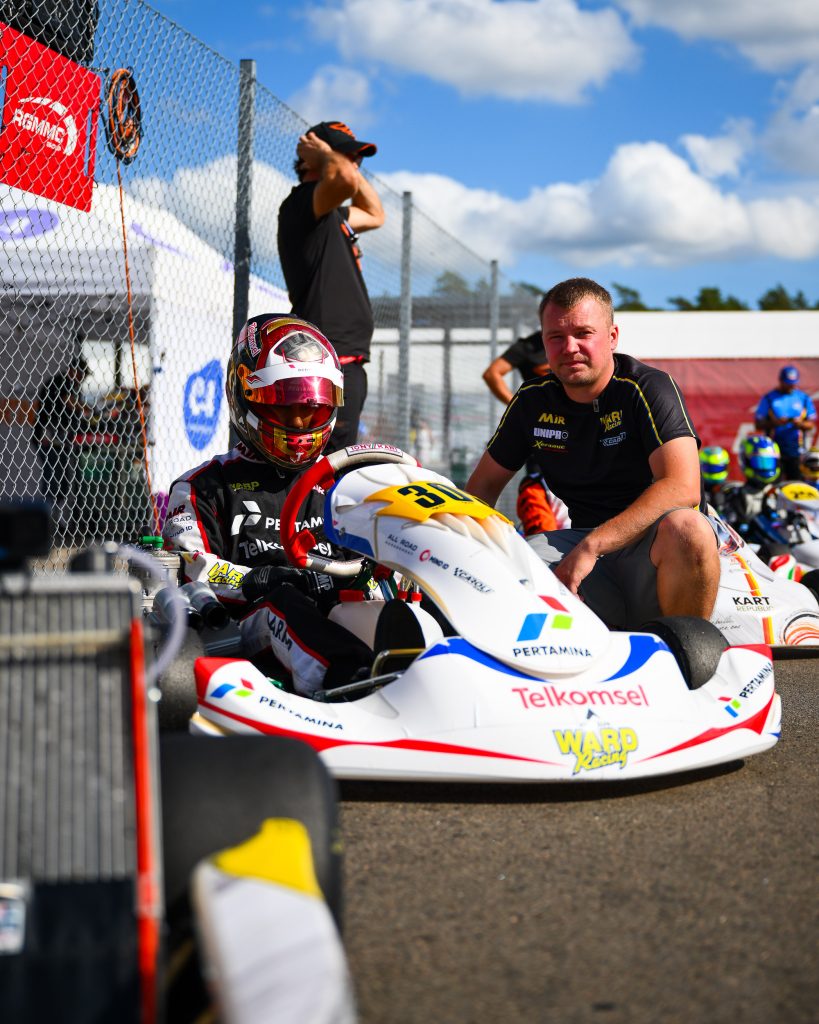
Cross-Training on Track: Why Drivers Switch Karting Categories
If you want to be good at a sport, sometimes it helps to practice a different version of it. For race car drivers, this means driving different types of vehicles to learn new skills. According to official race records, Qarrar Firhand didn’t just race in standard go-karts; he also spent time racing in a category called KZ2 with the LA Motorsport team. KZ2 karts are known as “shifter karts.” While standard karts are essentially automatic, shifter karts have manual gears and are much more physically demanding to drive. For an Indonesian Young Racer looking ahead to his future, driving a shifter kart is a smart way to practice the exact physical movements he will need when he finally steps into larger, more complicated race cars on his Road to Formula 1.
Key Differences: Standard Karts vs. KZ2 Shifter Karts
To understand why Qarrar practiced in KZ2 shifter karts, it helps to look at the main differences between a standard go-kart and a shifter kart. A shifter kart acts much more like a real race car in a few specific ways:
Using Gears: A standard kart only has one gear; you just press the gas and go. A KZ2 kart has a six-speed manual gearbox. The driver has to constantly push and pull a lever next to the steering wheel to change gears while driving at high speeds.
Standing Starts: In regular karting, the races usually start with all the karts rolling forward in a pack. In KZ2, the karts line up on a grid and start from a complete stop when the lights go out. This requires the driver to use a hand-clutch and balance the engine speed, exactly like a Formula 4 or Formula 1 driver does at the start of a race.
Front Brakes: Standard karts usually only have brakes on the rear wheels. Shifter karts have brakes on the front wheels too. This means they can stop much faster, which teaches the driver how to brake hard and late into a corner.
Technical Takeaway: Multi-Tasking and Building Physical Stamina
The main reason young drivers use shifter karts is to train their brains to do multiple things at once. In a normal kart, the driver only has to focus on steering, breaking, and accelerating. In a shifter kart, they have to do all of that while also counting their gears, listening to the engine to know when to shift, and using one hand to steer while the other changes gears. It teaches coordination. Also, because the front brakes are so strong, it gets the driver’s neck and arms used to the heavy forces of stopping quickly. By practicing with gears and strong brakes now, Qarrar ensures that when he gets into a larger race car, he won’t be overwhelmed by having to learn how to shift; he can just focus on driving fast.

