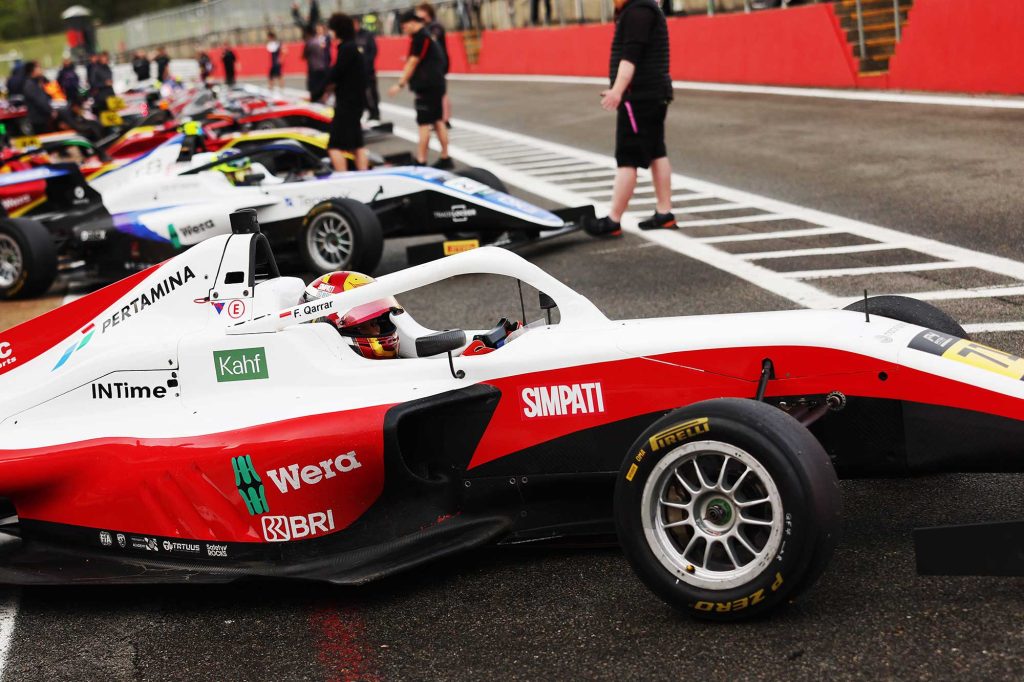
Learning to Shift: How Qarrar Firhand’s Karting Experience Prepared Him for Formula 4
From mastering shifter karts to competing in single-seater racing, how early technical skills became part of Qarrar’s transition to Formula 4.
From Karting Experience to Formula 4
In motorsport, every racing category teaches a driver something different. Moving between different types of vehicles helps develop the skills needed to progress through the racing ladder. For Qarrar Firhand, his experience goes beyond standard go-kart racing. He also competed in the KZ2 category with LA Motorsport, driving one of the most physically demanding types of karts.
KZ2 karts, commonly known as shifter karts, feature manual gears and require significantly more driver input than standard single-speed karts. This experience helped Qarrar develop skills that would become valuable when he made the transition to single-seater racing.
Now competing in Formula 4, Qarrar is applying that foundation to a much more complex racing environment, where drivers must manage not only speed but also vehicle dynamics, race strategy, and communication with their engineering team.
Key Differences: Standard Karts vs. KZ2 Shifter Karts
Understanding Qarrar’s KZ2 experience helps explain how different racing disciplines contribute to a driver’s development. Shifter karts introduce several technical challenges that prepare drivers for more advanced forms of motorsport:
Using Gears: Standard karts typically use a single-speed transmission, while KZ2 karts feature a six-speed manual gearbox. Drivers must constantly operate a gear lever while managing their racing line, throttle, and braking. This builds coordination and an understanding of gear selection that becomes valuable in Formula 4.
Standing Starts: Unlike many standard karting categories, KZ2 races feature standing starts. Drivers must manage the hand-operated clutch and engine speed to achieve a clean launch when the lights go out. This experience provides an important foundation for understanding the demands of standing starts in single-seater racing.
Front Brakes: Standard karts generally rely on rear-wheel braking, while KZ2 karts also feature front brakes. This creates greater braking performance and requires drivers to develop precise braking control, particularly when approaching corners at high speed.
Technical Takeaway: Coordination, Racecraft, and Physical Stamina
Shifter karting develops more than just driving speed. It trains drivers to manage multiple tasks simultaneously. In KZ2, a driver must steer, accelerate, brake, monitor engine response, and shift gears while maintaining the right racing line.
These skills provide a useful foundation for Formula 4, where the demands become even more complex. Drivers must adapt to a heavier car, aerodynamic downforce, adjustable suspension, and longer race distances.
Physical preparation also becomes increasingly important. The braking forces and sustained G-forces experienced in formula cars place greater demands on the driver’s neck, arms, and overall endurance. The coordination and physical conditioning developed through karting help provide a starting point for these new challenges.
For Qarrar, the transition from karting to Formula 4 represents more than moving into a faster vehicle. It is about applying years of racing experience while continuing to learn new techniques, understand racecraft, and adapt to the demands of professional single-seater competition.
Every racing category adds another layer of experience. From karting to Formula 4, every lap is another step forward on the road to Formula 1.
Stay connected, follow Qarrar’s journey, and be part of the team that drives the future — one lap at a time.

