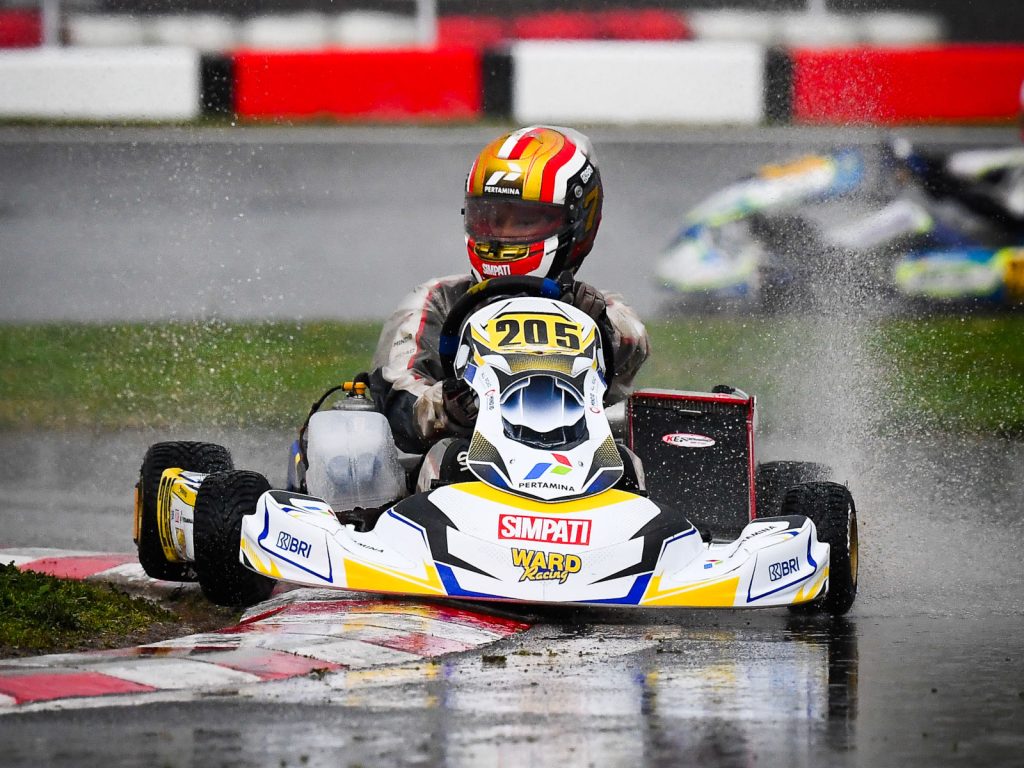
The path to the pinnacle of motorsport, Formula 1, is often described as a pyramid. At the base are thousands of young dreamers in go-karts; at the peak are only 20 seats in the entire world. For Indonesia’s Qarrar Firhand, this journey is not just a dream but a meticulously planned professional ascent.
This article explores the educational and technical stages of building a racing career, using Qarrar’s trajectory as a roadmap for the next generation of Indonesian speedsters.
1. The Foundation: Karting (The “University” of Racing)
Almost every F1 champion—from Lewis Hamilton to Max Verstappen—began in a go-kart. Karting is the purest form of racing because it teaches the fundamental physics of speed without the complexity of advanced aerodynamics.
- Precision and Reflexes: In karting, the distance between the driver and the asphalt is only a few centimeters. Drivers learn “racecraft”—the art of overtaking, defending a line, and managing tires.
- The European Shift: Qarrar Firhand moved to Italy at age 11 to compete in the WSK (World Series Karting). This is a critical educational step. European tracks are faster, more technical, and the competition is the fiercest in the world. Success here proves a driver can handle high-pressure environments.
2. Technical Mastery: Data and Discipline
Modern racing is as much about the mind as it is about the feet. Qarrar’s training involves more than just driving:
- Telemetry Analysis: Drivers must learn to read “squiggles” on a graph—data that shows exactly when they braked, how much throttle they applied, and where they lost milliseconds.
- Physical Conditioning: A formula driver’s neck must support the weight of their head and helmet under 4-5G of force. Qarrar’s regimen includes intensive cardio and strength training to ensure 100% “F4 readiness.”
Mental Fortitude: Using “Formula Medicine” and simulators, young racers train their brains to remain calm while their heart rate is at 180 BPM.
3. The Leap to Single-Seaters: Formula 4 (F4)
In 2025 and 2026, Qarrar Firhand is transitioning from karts to Formula 4. This is the first “real” car in the FIA Global Pathway
Feature | Karting | Formula 4 |
Brakes | Rear only (usually) | Full hydraulic disc brakes |
Aerodynamics | Minimal | Front and Rear wings (Downforce) |
Shifting | Direct or Sequential (Shifter) | Paddle shifters on the steering wheel |
Strategy | Sprint intensity | Pit stops and fuel management |
For Qarrar, choosing British F4 is a strategic educational choice. The UK is the “Silicon Valley of Motorsport,” home to most F1 teams, providing the best networking and technical exposure for a rising talent.
4. The Super License Point System
To reach F1, a driver doesn’t just need talent and money; they need a FIA Super License. This requires:
- Being at least 18 years old.
- Accumulating 40 points over three seasons.
- Points are earned by finishing in the top positions of F4, F3, and F2 championships.
5. Why Qarrar Firhand Matters
Qarrar is redefining the “Indonesian Racer Identity” by proving that an Indonesian athlete can compete as a “homegrown” talent on European soil from a very young age. By joining professional setups like Parolin and All Road Management (the same team that managed F1 legends), he is showing that the gap between Southeast Asian talent and Global F1 standards is closing.
Summary for Aspiring Racers:
- Start Early: Most pros start between ages 5 and 8.
- Go Global: Local success is great, but international benchmarks are necessary.
- Education First: Understanding the engineering and data is just as important as the steering wheel.
Qarrar Firhand’s journey is a masterclass in dedication. As he moves toward his goal of reaching F1 by age 21, he carries the hopes of a nation and serves as a living curriculum for anyone daring to chase the world’s fastest dream.

